The Echo of Collective Blur
"This is what it looks like when one tries to see collective blurriness — and fails."
descend into the archive
"This is what it looks like when one tries to see collective blurriness — and fails."
What we see — or fail to see — is not collective blurriness itself, but the impossibility of rendering it visible. And therein lies its power.
The image does not disclose; it resists. It offers no clarity, no object, no answer — only a trembling residue of perception, unreliable yet palpable. In a world where visibility is the currency of truth, this refusal becomes radical. The image is not evidence. It is disturbance.
Collective blurriness names a state in which perception, knowledge, and relation are porous and indeterminate — not a lack, but a generative condition.
To embrace this blur is to resist hegemonic clarity. It becomes both an epistemic stance and a political gesture.
Wild research counters standardised, linear, institutional models of knowledge. It seeks not clarity but resonance — a poetics of not-knowing.
Research here becomes an aesthetic movement through blind spots: fragmentary, tentative, multiperspectival. The project unfolds as an archive where sound, image, video, and text intertwine. Visitors navigate freely — choosing their own paths and rhythms. Reading itself becomes research: knowledge emerging through movement, resonance, and situated attention, not through order.
Please don't feel obliged to read this piece dutifully from start to finish — it was made for drifting, like a stroll through a rhizomatic field of thought.
A Speculative Trace Inquiry. Fissures open between the lines of official maps — places that ought not to exist, or were never meant to.
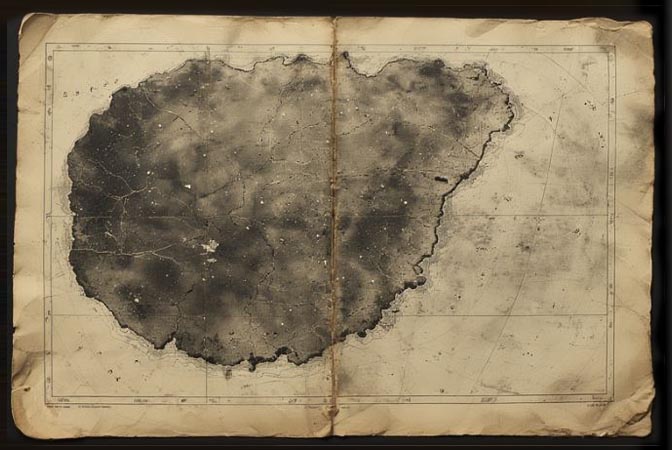
The Maratongo Delta is one such place: a geo-cultural phantom that appears fleetingly in early colonial sources and vanishes from later records. What remains are fragments — maps, reports, images, sounds. Traces, nothing more.
You can't really read through this article. You can only enter, linger, and leap on — like joining a conversation with no centre.
Nothing here is in order. Drag the pieces around. Touch a photo and it stirs. Double-click anything to pull the full file.
Drag with mouse or finger · hover a photo · double-click any piece for the full file
Extract with footnotes — tap a marked number to open the annotation.
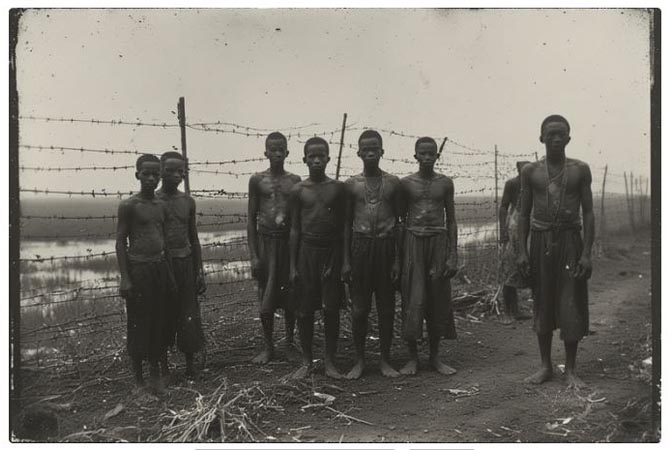
The so-called Camp Maratongo could only be observed from a distance; any attempt at direct approach was met with firm refusal. The local population consistently withheld information, responding with silence or evasive gestures. The camp itself appeared as a provisional yet remarkably well-structured facility. Despite its apparent order, there was a complete absence of cultural artefacts or traditional objects[1] — an absence that suggests a deliberate dismantling or erasure of familiar communal structures.
This lack of established cultural markers may indicate that the camp served not only an administrative function, but also operated as an instrument of control and disciplinary restructuring[2] — a site where identities were dismantled and reassembled. The visible efficiency of the camp's internal organisation stands in stark contrast to the linguistic and social absence of its inhabitants, whose histories and lifeways appear either silenced or erased.
The investigation was hindered by an insurmountable distance — both physical and symbolic — raising the question of whether the Maratongo Delta represents a site of actual events or a cartographic phantom shaped by colonial projections of power.[3]
Filter the entries by what unsettled Dr Renk most.
A sweetly musty odour hangs in the air — not quite foul, not fresh either. The porters refuse to enter the water. One whispers, with noticeable unease: "That is where the paths disappear."
The 1912 map clearly indicates a camp in this area. Yet on site: nothing but dense fog and distant traces of smoke. Time appears unstable — light and shadow shift with no discernible rhythm.
Voices during the night — indistinct, distant. No identifiable direction to the sound. My assistant insists they were coming "from beneath the waterline."
Found a corroded metal tag in the mud, engraved: "M.G.B. — Section 7." I kept it, yet by the next morning it had disappeared — as though the delta had reclaimed it.
The same plate, read two ways. Drag to move between the record and its residue.
As in the archive itself, the reading order here is not yours to plan. Draw a fragment at random.